Saints and Swimmers

The thermometer screamed “103” and then cried for mercy.  The concrete around the pool was significantly hotter, fulfilling its role in the cruel game it had coauthored with the pool itself.  The latter promising sweet respite from a sweltering summer day.  The former torturing the soles of even the toughest feet on their pilgrimage to promised relief.

 I watched this game unfold from beneath an enormous triangular umbrella suspended above the corner of the Minden Community Pool.  I try not to go to the pool for biological reasons – bacteria, viruses, genetic mutations caused by ultraviolet radiation, and because I’m large and hairy.  As progressive as I have become, I still believe it’s my wife’s job to take the kids to the pool. 

But in a grand and humble display of mutual submission, I grabbed some towels from the basement, plastered my girls with sunblock, begged and bargained for them to wear hats and long-sleeved shirts, squished their slippery bodies into the back seat of my Forester, forgot the towels, and drove the six blocks, hearing a ghostly chant, “Dead man walking” the entire way to my execution chamber. 

I never know what to do at the pool.  I once took a book, but this sparked an unsolicited conversation with a stranger – a twelve-year-old boy.  He asked me what I was reading.  Prepositions in the Greek New Testament.  Cool, he said.  I didn’t ask, but he told me what he had been reading.  Twilight.  Darn books. 

But as hard as I’ve tried, I’ve only come up with one other option – watching.  But how does one watch people at a public swimming pool without looking like a creeper.  Sunglasses on – he could be looking anywhere.  Sunglasses off – everyone knows where I’m looking.  It’s a real catch-22.  So I look at the ground.  Then the sky.  Then the ground.  Then behind me even though I know there is nothing there.  Then my arms, flexing my biceps but knowing right away that this is strange.  Then my children because this is a special moment.  Then the ground.  Then the sky. 

Then a sign catches my eye.  Next to the bathhouse, down by the deep end, positioned like it doesn’t want to be read, is a large sheet metal sign affixed to the wall.  I would say about three feet wide and five feet tall.  The font looks old and maybe hand-painted, but it’s probably too precise and too wordy to be old and hand-painted.  The title tells me that these are the rules of the pool as handed down by the Nebraska Department of Health.  One commandment immediately hooks me and reels me in without a fight because I see the word “nude.”  That word is as intriguing to me now as it was when I was a twelve-year old boy.  “Before entering the pool, all swimmers must take a shower in the nude with soap and water.” 

I cannot contain my smile, so I put my hand over my mouth and squint, like I’m having a profound thought or like I’ve been living on a remote island and my stomach hurts because it’s weird to go number two in an outhouse while someone is waiting outside for you to finish.  But the shaking of my stomach betrays me. 

What in the world happened, somewhere in Nebraska, that the state had to write a rule containing the phrase “in the nude with soap and water?”  I’m imagining all kinds of scenarios.  “Eight local middle schoolers disappear from public pool.  Officials suspect they showered with their bathing suits on.”  “Mother of three contracts giardia from public pool.  She says she didn’t shower because she just took a bath while her husband cleaned the house.”  “Elderly man struck blind because he only showered with soap.” Is that even possible?  Is not “water” implied in “shower.” Maybe not.  People are crazy these days. 

I learned a lesson that afternoon.  When you read something unexpected, you should ask, “What must have happened to cause someone to write that.”  I’ve read something else unexpected, shocking even, and it didn’t contain the word “nude.” And it’s a lot older than the sign at the Minden Community Pool. 

For all of you who were baptized into Christ have clothed yourselves with Christ. There is neither Jew nor Greek, there is neither slave nor free, there is neither male nor female – for all of you are one in Christ Jesus. 

What in the world happened to cause the apostle Paul to write this?  The answer is, I’m sure, multifaceted.  This passage has been used to prove a lot of points.  But what must have happened?  Would Paul have written anything like this to our churches?  Probably not.  To the churches on my attendance resumé, Paul would have written this: There is Greek, there is free, there is (for all practical purposes) male…Never mind.  The most obvious reason that Paul wrote this is because the body of Christ in Galatia was composed of all of these kinds of people, and probably more.  Jews and Greeks.  Slaves and free.  Males and females.  Educated and uneducated.  Rich and poor.  Republican and Democrat.  American League and National League.  Cilantro lovers and cilantro haters.  Vegan and Paleo.  Wine and grape juice. Homeschool and Public School.  Young earth and old earth.  The list could, and should, go on and on. 

Christ obliterates these differences.  How?  Paul prefaces this bold assertion by referencing our baptism into Christ.  Baptism is death and resurrection.  At Ovilla Road Baptist Church, in the summer of 1989, Brother Nick, my pastor, just before he pushed me under the water one Sunday evening said these words, in his kind and caring Tennessee drawl, “Curtis, what is your profession of faith?”  This profession unites us despite our differences.  I probably said something like, “I just believe that Jesus is just really awesome and that sin is just really bad, and like, I can be in heaven if I just ask Jesus in my heart, and it feels awesome to be saved, oh, and that he is God’s son.”  I butchered it, but God accepted it. 

Next, barely hearing it because I was headed under water, “Buried with Christ in baptism.” Without Christ, we are all equally buried.  But by faith, we can be buried with him.

Finally, hoping he could lift me up, “Raised to walk in newness of life.” In Christ, we are equally raised.  Gifted and challenged.  KJV and NLT.  Soda and Pop and even Coke.  Brisket and pork shoulder.  Unity without uniformity.  In the Greek, this passage begins with Christ and ends with Christ.  Maybe our churches should do the same. 

I guess I don’t mind, so much, taking my kids to the pool.
Doubts and Dermatology

“Come to me, all you who are weary or burdened, and I will give you rest.”
Matthew 11:28
Why, my soul, are you downcast?
Why so disturbed within me?
Put your hope in God,
for I will yet praise him,
my Savior and my God.
Psalm 42:11

I’m not sure exactly what  “guilty pleasure” means, but I have always used the phrase to refer to something you enjoy about which you are or could be (if you cared) embarrassed.  I’m not sure I’m embarrassed about this, but one of my guilty pleasures is watching medical procedures.  I saw my first on PBS when I was probably in 5th grade — a hip replacement.  My stomach dropped a bit, but I couldn’t change the channel, especially when the power tools appeared.  The next one was a procedure where a child’s face was being reshaped.  I don’t remember too many details other than that the face from the hairline down past the ears had been separated from the underlying structure.  The surgeon would flip the face skin down, chisel on the bones, and then flip it up to see the progress.  About the only thing I can’t stand to watch are compound fractures of the lower leg.

I have recently discovered “Dr. Pimple Popper. ” I never planned to watch it, but there it was, and I could not look away.  Lipomas emerging to take their first breaths and different flavors of cysts faithfully spewing forth their contents.  Years ago I would have simply been intrigued by the science of the matter.  But now I care much more about the souls than the science.  What matters to me about this show are the people who are either so scared of doctors or so embarrassed about their bodies that they let these issues (and tissues) grow for years before seeking help.  I can relate to that.  I’m not scared of doctors like I’m scared of snakes or popping balloons, but I know what it’s like to put off medical concerns for years because of fear and embarrassment.  Some would rather die in pain than deal with the issue.  Ignorance is bliss.  But, according to G.I. Joe, knowing is half the battle.

One the most striking lesson I’ve learned from Dr. Pimple Popper is that the doctor has seen it all.  Never is she scared.  Never is she shocked.  Never is she embarrassed.  Never is she intimidated.  She cuts it and squeezes it and compares it to mashed potatoes. And if she can’t, she tells you that you’re beautiful and to stop worrying.  Does God not do the same for us?

We sit on our painful doubts and dark thoughts about God and what he is doing or allowing to be done in the world.  We cover them with hats and scarves and wear our hair down so that no one knows.  Maybe we just stay home and hide.  We tell ourselves that our doubts are embarrassing, that they make us unattractive and unacceptable.  We cover them with duty, activity, and claims of false security, but we know what others do not or cannot see.  If we bring these doubts to God, we fear that he will respond with a “well I’ve never seen one of those before,” or even “it’s too late to do anything about it now.”  But this simply is not true and never has been.  He has seen it all.  What you think is abnormal and grotesque, he has dealt with thousands of times (figuratively, of course, because I’m not sure how to apply numbers and time to God).

My doubts are often burdens that I am ill-equipped or perhaps just not designed to carry.  Jesus promises to take this burden and exchange it for his.  This doesn’t mean that my doubts are resolved or my questions answered.  But it does mean that my hope is renewed in a Person who can bear it.  He is not intimidated, and I am not embarrassed or ashamed.  In fact, my only regret is not coming to him sooner.

Landscapes and Bodybuilders

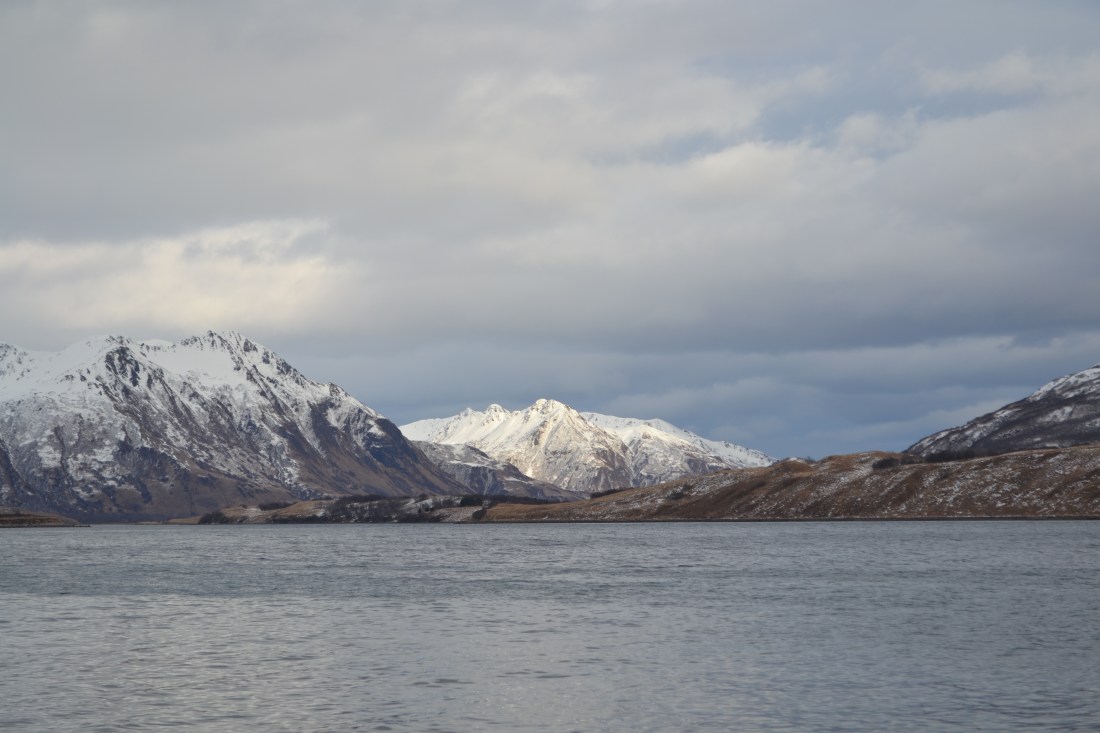
I’ve been living in Alaska for almost two years now. Its beauty did not draw me, but it is keeping me, pulling me in storm by storm, sunrise by sunrise.  I spent eight years in Nebraska before I moved here.  The beauty of Alaska strikes you immediately and requires little initial interpretation, but Nebraska’s beauty is more nuanced.  There are two times a year that I find Nebraska beautiful.  In late spring, the deep and seemingly honest green of corn plants, not yet a foot tall, juxtaposed against the still visible black soil is a study in contrasts and makes me thankful that I can see the beauty of blacks and greens.  Then there is a time in the fall, after harvest, where the landscape is dominated by several shades of gold – from the bones of cornstalks still remaining in the fields with their splintered skeletons covering the soil to the surrounding grasses and trees whose chlorophyll has conceded to the other pigments. Combine any of these scenes with a Nebraska sunset, uncensored by buildings constructed by man or created by God, and it is enough to inspire and enliven even scabby souls like mine.

This is all well and good, at least as a description of a corn field can be, but I have always found Nebraska wanting – well, not always, but at least since I moved to Alaska.  This Nebraska beauty I have described, though it is beautiful is not quite true.  It’s like a photograph of a swimsuit model after it has been Photoshopped.  When I take in these scenes, the appreciation and inspiration is obscured by a part of me that wonders what it looked like before.  Before genetically modified seeds were planted in rows plowed by a GPS controlled tractor whose sticker price would rival any European supercar.  Before giant sprinklers sprayed water in precise amounts, with perfectly sized drops engineered in a laboratory, as they claw around in circles like beasts of burden that never have to be led or fed.  Before weeds were killed at just the right time by spraying everything with Roundup and then waiting for the harvest.  Before crop insurance and subsidies.  Before the stretch marks and cellulite were erased and the thigh gap added.  Before men tamed God.

The beauty of Alaska is not so.  Women and men who make their living on the seas have very little in common with the farmers I know.  Their insurance doesn’t protect them from weather or from fish who, for whatever reason, didn’t wander their way this year.  Even the best technology cannot create ex nihilo.  I can look out the window of a bush plane, my office, my living room, well, really any window anywhere in my village, and I do not have to wonder what it looked like before.  The waters have not been restrained and diverted nor are the waves controlled for the convenience of those who work on them.  On Kodiak Island, there is no lack of blacks and greens, bordered by clarion blue-gray waters.  Mountains teeter on the ocean’s edges.  How they remain standing in the storms I do not know.  They remain as they always have, on their terms, and we are at their mercy.  Beaches come and go with the tides, sometimes like the steady rhythm of a peaceful heart, other times like the heart of an out of shape science teacher running a 5K, where you’re not entirely sure what will happen next – will it pound so hard that it might break through or will it just stop?  I have found beauty, and a strange kind of peace, in the uncertain and unpredictable, in living in a land where neither my brain nor my brawn can change things.  I once posted a picture of the view from my front porch and wrote something profound about the land in which I have been placed.  But I told a friend of mine that living here is really like making out with a bodybuilder.  Now, I have no personal experience in making out with a bodybuilder.  My wife is a body builder, as evidenced by my three wonderful daughters, but she is not a bodybuilder.  But I imagine, when I was 16 I probably imagined things like this frequently, that making out with a bodybuilder could be a lot of fun unless she got angry, or bored, and decided to twist this or break that, flaunting her power over me.  And even in the deepest and sweetest embrace, she reminds me that she is in charge.  That is Alaska.

For much of my history as a follower of Jesus, life in the Spirit was a lot like the beauty of Nebraska.  It had an appeal and a predictability and an appearance of beauty, but much of it was contrived and controlled — controlled by upper middle class white guys who plowed precisely and planted perfectly.  Stuff even grew, but God was tamed.  What didn’t grow right or look right or sprouted up out of line was simply killed with an indiscriminate application of theological Roundup or a generous dusting of labels like “liberal,” “watered down,” and “heresy.”  Yield and uniformity, after all, is what’s important.  Acres and bushels turn into attendance and capital campaigns for building programs – buildings that will be perpetually empty except for a couple of hours a couple of times a week.  It’s all corn, corn as far as the eye can see.  It can be pretty, and can even be pretty useful, but it is not entirely true.  Over the last several years, I have found an Alaskan theology exceedingly more beautiful – primarily because I know that I don’t and that I can’t control it.  Not only can I not control it, I can’t predict it, manage it, organize it, or alliterate it in a snappy sermon.  Even when grace allows me to get my hands on it, to participate in its pleasures, and to experience its benefits, there is never any doubt about who is in control.  Well, maybe there is some doubt, but there is no doubt that it is not me.  And that is also grace.  The God I serve and seek is beautiful and true, but he is not tame.

A Week in Words

I just finished a week in words.  Words spoken.  Words heard.  Words written.  Words read.  Public words.  Private words.  Published words.  Pressing words and blessing words.  Words that profit.  Words that cost.  Sacred words.  Mundane words.  Words of sickness.  Words of healing.  Sweet words.  And a few salty ones.

In the beginning was the Word, and the Word was with God, and what God was, the Word was.

John doesn’t tell us that Jesus is the Word.  He gives us no list of characters or an asterisk and footnote to let us know that Jesus equals the Word.  He just does it.  Decades after Jesus left him physically, but still, and even more so, in his presence through the Spirit, John has reflected on the life of Jesus – from birth to ascension, stories that we know, and stories that John knows but doesn’t tell – and calls Jesus the Word.  Not the way.  Not the truth.  Not the life.  Those will come later, and Jesus uses them and others of himself.  But John calls Jesus the Word.  Why? And why does it matter?

Some say the Word is a Greek, philosophical concept.  Others say that it’s a Hebrew idea, like the words of a prophet. Maybe. But I think John answers this question for us if we look closely.  He continues, The Word was with God in the beginning.  All things were created by him, and apart from him not one thing was created that has been created.  Words create.  Words bring ideas into existence.  Words are the closest thing I have experienced to creating something out of nothing.  In fact, it is possible that this sentence has never been written before.  It now exists.  Seconds ago, it did not.  I heard a really smart lady on NPR assert that thoughts do not exist without words, so children cannot think until they have words.  My wife, wanting to believe that our children have been brilliant from birth, disagreed, but I told her that NPR doesn’t lie.

Jesus is a creator.  He creates followers and disciples.  He creates healing and peace.  He creates neighbors out of enemies.  He creates light and life.  He creates joy where there should be only sorrow.  He creates courage and boldness where there should be only fear.  He creates freedom where there should be only bondage.  He creates brokenness where there should be only pride. He creates his people. We come to him with nothing, empty handed, and he goes to work.  It was [Christ] who gave some as apostles, some as prophets, some as evangelists, and some as pastors and teachers, to equip the saints for the work of ministry, that is, to build up the body of Christ.  He not only creates his people, he creates their unity.  For in Christ Jesus you are all sons of God through faith.  For all of you who were baptized into Christ have clothed yourselves with Christ.  There is neither Jew nor Greek, there is neither slave nor free, there is neither male nor female – for all of you are one in Christ Jesus.

We should not be surprised by this.  Words, after all, brought everything into existence.  Our universe did not arise from blood spilled in a battle between the gods but by words spoken.  John is telling us that this has not changed.  Words marked the advent of creation, and the Word marked the advent of re-creation.  It is then the nature of Jesus to create.  Depression, addiction, fear, guilt, shame, lust, pride, anger, idolatry.  These are not obstacles for this creative Word.  They are materials.  This Jesus who in love accepts our divided devotion and fragile faith has not and will not stop creating.  So then, if anyone is in Christ, he is a new creation; what is old has passed away – look, what is new has come!

Neglect and Obsession

I just watched “Whiplash.” When Amber asked me what is was about I told her that it was about the obsession that it takes to become the best and the lines that some are willing to obliterate to help others become the best.  I then added that part of me wishes I had that obsession about something but that most of me was glad I didn’t.  Amber then pointed out that I should be that obsessed about writing and observed that I had not written anything since my really expensive writer’s conference. So I guess I’ve traded obsession for neglect — which can be its own kind of obsession.  I still haven’t written anything new, but the post above is something old — written during the conference I attended last September.

Shapes and Stories

The following explains the name of this blog and my story in a nutshell:

When I started loving Jesus at the age of 13, I was given a child’s shape sorter – that plastic spheroid with holes and blocks in different shapes.  The kid is supposed to be able to match the shape of the block to the shape of the hole and deposit the blocks into the sorter swiftly so that mom and dad can proclaim to the digital universe that their child is a genius. Only, my shape sorter did not have four or five shapes.  It had one.  Let’s choose the triangle.  So, I have a shape sorter with one hole – a triangle – and this is supposed to help me make sense of things and to love Jesus more.

This is really great because life, I was told, is full of triangles.  Well, not exactly full of triangles.  There are some triangles, but there are also occasional squares.  No problem.  I learned to cut the square in half diagonally, and now I have two triangles.  Everything fits.  What if a circle comes along? A little trickier and a little more work, but I can cut it into fourths or sixths or eighths, and each slice will be roughly triangular – like a slice of pizza.  Everything fits. But then, maybe behind the scenes, the adversary puts God to the test, and God allows the devil to toss a star-shaped block my way.  No worries. It’s okay because I’ve learned that the shape doesn’t have to fit well, it just has to fit in.  I hold the star with a pair of long handled pliers over the triangle hole with one hand, apply a flame to it with the other, and I watch the plastic melt, acrid smoke ascending and molten polymer descending through the triangle into the bowels of the shape sorter in bright yellow globules.  Everything fits.  Life coheres.  Jesus is loved.

This was the system I learned.  This was how I was supposed to make sense of life and death, pain and suffering, good and evil, things in my own life that didn’t make sense, things I read about in an ancient Story that didn’t make sense.  Everything has to fit, and, if it doesn’t, I twist and turn, reshape and redefine, sever and scorch, until it does.

I donated my shape sorter to a thrift store a few years ago.  They threw it in the dumpster because it only had one hole and was filled with an amorphous plastic blob.  Told me it wasn’t fit for children.

I left that child’s toy in the thrift shop dumpster and took home a book in its place.  It was obviously used.  It smelled like old paper.  The cover called to me.  Some kind of thin fabric stretched tightly over book bones.  Stretched so tight I could see the strain in its fibers.  Some of the fibers had given up or given in and turned upright, perpendicular to the cover, like a few of my eyebrows do toward the end of a long day.  My wife pleads for me to excise these snarky rebels.  I name them instead.  The title was worn away, but part of the subtitle was still visible.  “The Story of…”  Surrounding these words was a ring formed by what I do not know, but I suspect a wine glass whose contents had runneth over.  This brown circle betrayed its crimson genesis.

The pages of this book, oh, the pages.  They are full of heroes and monsters, life and death, victory and defeat.  They are full of creation and destruction, healing and affliction, courage and betrayal.  They tell a story of redemption, restoration, and re-creation.  Many of the pages are blank, but the story is not entirely unfinished.  There is a lengthy beginning though it does not answer all of my questions.  There is an end, fairly brief, saying little about how and when but a lot about Who.  Most of the empty pages are in the middle.

It took me awhile, but I figured out that I am writing my story in these blank pages.  My own heroes and monsters, courage and betrayal, redemption, restoration, and re-creation.  Here there is no twisting and turning, no severing and scorching to make things fit.  There is writing, reflecting, and maybe some rearranging.  There are even exclamation points and question marks.  It is not easy.  I often do not know where to write what or how this fits with that.  But knowing the end, and knowing that I have not run out of room, I am less compelled to force the middle to make sense.  This is, after all, a work in progress. So, get rid of the child’s toy and pick up a good book. Because life does not come at us in shapes but in stories.


And so it begins…again

The fifth, or maybe sixth, times the charm.  I can’t document it due to old email accounts lost in cyberspace, but I would guess that this is the fifth blog I’ve created.  In fact, when I created this one, I learned that I already had one on this host.  I never posted anything, never started anything.  So here I am again.

Why write a blog?  I’ve read a lot of blogs that smell of “my life is so interesting everyone else should know about it” or “my opinions are so novel everyone should know about them.”  My life is neither that interesting nor are my opinions novel.  My opinions, even about important things, are all over the place, some would say incoherent, and I would hesitate to make them public today as they might change tomorrow.  My life is truly unremarkable, at least to me.  The most interesting about me, without a doubt, is that I live a a rural Alaskan village on Kodiak Island.  But my life there is quite mundane.  I don’t hunt, and I’m a spectacularly poor fisherman, though I gladly welcome gifts of salmon, halibut, cod, crab, and venison from others.  I’m a teacher at a small school — not even 30 students K-12.  Two of those are my daughters Claire, age 11, and Ruby, age 8.  Penelope, age 4, goes to preschool.  When she’s not at preschool, she hangs out with my wife, Amber, at her office.  She works for the Alutiiq Tribe of Old Harbor as a women’s wellness advocate.  We’ve been here for a year and plan to be hear for about one more.  Stay tuned to see where we go next.

But why write a blog?  To put it briefly, I think that someone out there, somewhere, might share my struggles, particularly my struggles with faith, the cultural faith I inherited by birth into the Bible belt, the faith I embraced personally as a teenager, and the faith I have struggled with even as I embrace it now.  If you haven’t shared these struggles, you know someone who has, even if you don’t know it, and maybe my story will help you understand that those of us who struggle still have something to contribute.  I don’t know.  Maybe.  We’ll see.